Introduction – Atlético-MG vs. Vasco Da Gama
When the teams took to the field at Arena MRV in Belo Horizonte for the final match of the 2025 Brazilian Championship, what was expected was a farewell game—for many, a simple formality amidst the end-of-season routine. For Atlético-MG, it was a chance to send a message to the fans, to show that there is substance and pride in the club even after a turbulent year. For Vasco da Gama, the expectation was to end with dignity, secure a continental spot, and avoid the bitter taste of an inconsistent campaign.
But football, as always, had something bigger in store. Atlético-MG entered the game hungry, organized, and with a visible desire to prove their strength. The Arena MRV, often a stage for criticism and uncertainty, transformed into fertile ground for an intense, aggressive, and precise performance. The players showed soul, collective cohesion, and a tactical awareness that seemed absent in recent matches—high pressure, quick counter-attacks, offensive mobility, and patience in seeking space were the pillars of their offensive build-up.
On the other side, Vasco seemed lost. The fragile defensive structure, the positioning errors, the lack of creativity in midfield, and the collective disorganization made the mission almost impossible from the start. The expulsion of a player in the first half aggravated the crisis—the team was weakened, without competent full-backs, without an attacking midfield, and with the defensive system leaking during transitions.
The result was more than just a score: it was a warning. The 5-0 defeat not only cemented Atlético-MG’s dominance on the day, but also exposed Vasco’s shortcomings for all to see. This match serves as a watershed moment—both for those seeking to rebuild and for those who urgently need to rethink. In the end, football shows that preparation, attitude, and collective competence overcome any individual or historical instability.
Pre-game analysis – Context, club status, and the emotional weight of the last Atlético-MG vs. Vasco da Gama match.
Atlético-MG’s situation
Atlético-MG arrived at the final round with the mission of ending the year with dignity. The inconsistency in the championship, the fluctuations in performance, and the criticism from the fans demanded a response. Playing at home, in front of their fans, became an opportunity for rapprochement, rebuilding confidence, and affirming that the club still had concrete ambitions for 2026.
There was also the personal motivation of experienced players who wanted to show that Atlético Mineiro could improve. The coaching staff got the strategy right: aggressiveness, width on the flanks, quick transitions, presence in the opponent’s area, and well-executed finishing. The plan was clear: exploit any opening and kill the game early.
Furthermore, ending the year at home generated expectations of celebration—and the group seemed aware of the chance to transform the finale into a symbol of rebuilding. The fans knew the moment and expected commitment. The emotional energy preceded the opening whistle.
Vasco da Gama’s situation
For Vasco, the game carried a heavy dose of nerves and accumulated pressure. Throughout the season, the team had fluctuated greatly, showing strengths but also serious defensive weaknesses, offensive inconsistency, and tactical adaptation problems. The possibility of finishing in a dignified manner and securing a place in the Copa Sudamericana was the minimum expected.
But the conditions were not favorable: distrust from the fans, alternative players in the team—since the club prioritized the Copa do Brasil semi-final—and a recent history of lackluster performances. The expectation was for defensive adjustments, tactical organization, and a focus on transitions. The mission: to resist, find balance, and avoid a rout. A task that demanded maximum concentration and collective coherence.
The atmosphere was one of uncertainty. Vasco needed to show good football, but above all, good attitude—and it was difficult to imagine that the combination of a strong opponent and a full house could be favorable without solidity.
The game – Pace, goals, sending-off and absolute dominance of Atlético-MG vs Vasco Da Gama
First half – Pressure, sending-off and lead built.
Atlético-MG started the game with evident intensity. High pressure, aggressive marking, and offensive movement to disrupt Vasco’s build-up play. The strategy worked from the first minute. In just a few passes, the team was already circling the penalty area dangerously, forcing the opponent into errors.
In the 18th minute, after a free kick from the right and a defensive lapse, Júnior Alonso took advantage of a rebound and opened the scoring. The crowd cheered, and Vasco felt the blow. The defensive disorganization was evident — poorly positioned full-backs, disjointed midfield, and coverage failures.
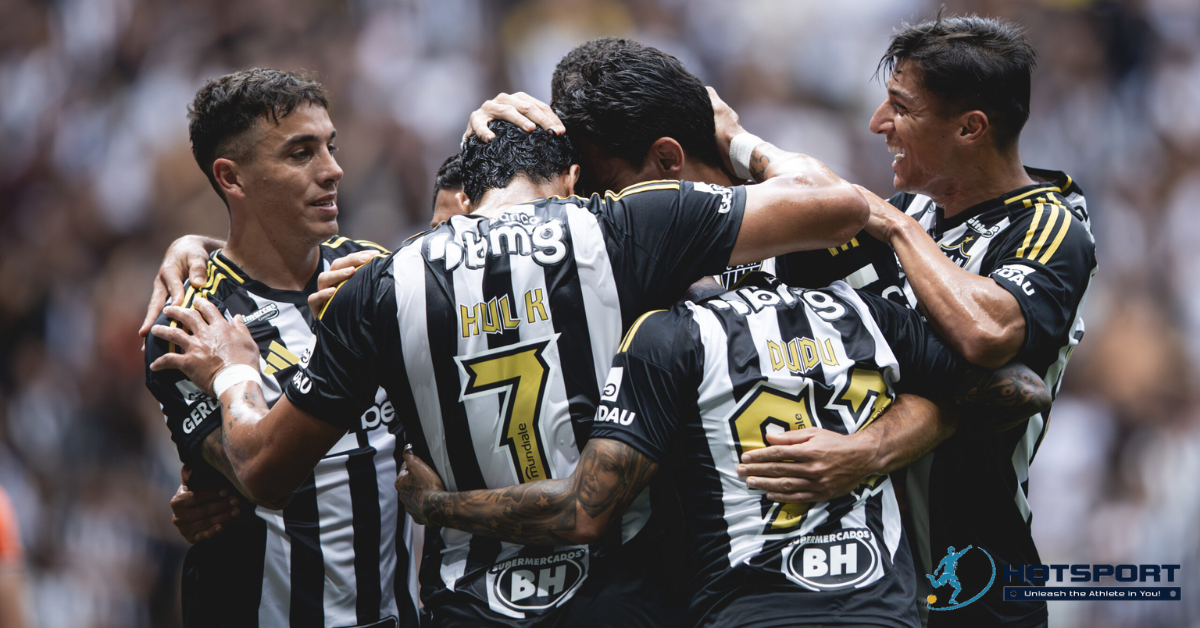
Shortly after, at the 30-minute mark, the game completely turned around: Vasco lost a player to a red card (for a studs-up tackle). The numerical advantage accelerated Atlético’s plan. At the 32-minute mark, from a long-range free kick, veteran Hulk unleashed a powerful, unstoppable shot, making it 2-0. The crowd went wild, the atmosphere changed—the game seemed decided well before halftime.
Despite the intense pressure, Atlético Mineiro maintained their rhythm. Shots on goal, crosses, and offensive movements continued. Vasco, cornered, tried to reorganize, but without success. The first half ended with absolute dominance from the Minas Gerais team—possession, chances, and control of the game.
Second half – Effectiveness, expansion and Minas Gerais celebration
If the first half had already shown superiority, the second confirmed it. Atlético returned with the same hunger, but with patience to manage the spaces and exploit Vasco’s weaknesses. The intensity dropped a little, but the focus increased.
Just four minutes into the second half, Dudu finished well after a run into the box and scored the third goal. The crowd cheered, and Vasco saw any chance of a comeback vanish. From then on, Atlético Mineiro exchanged passes, controlled the tempo, maintained possession, and waited for the right moment.
At 24 minutes, Dudu was effective again: a quick one-two, a run into the box, and it was 4-0. The score already seemed excessive—but Sampaoli’s team didn’t stop. At 30 minutes, in an attempt to clear the ball, the opposing full-back scored an own goal, sealing the 5-0 victory and confirming the biggest win in recent history between the clubs.
Even with a comfortable lead, Atlético maintained their focus. They didn’t relax. The pace only slowed down to manage the game, but the full-backs remained active, the midfield held possession, and the attack circled the penalty area—objective and serious until the final whistle. Galo finished the year with authority, Vasco left humiliated.
Complete statistics – Numbers that reflect Atlético-MG’s dominance over Vasco da Gama.
| Statistic | Atlético-MG | Vasco da Gama |
|---|---|---|
| Goals | 5 | 0 |
| Total shots | 22 | 3 |
| Shots on target | 10 | 0 |
| Clear opportunities created | 6 | 0 |
| Estimated xG (Expected Goals) | 2.87 | 0.12 |
| Average ball possession | 59% | 41% |
| Accurate passes | 591 | 399 |
| Pass accuracy (%) | 91% | 85% |
| Corner kicks | 8 | 1 |
| Disarms | 16 | 9 |
| Ball losses | 98 | 121 |
| Saves by the opposing goalkeeper | 0 | 5 |
| Red cards | 0 | 1 |
The data shows that the dominance was not fleeting: Atlético-MG was superior in volume, objectivity, offensive precision, and defensive control. Vasco, on the other hand, failed to create anything significant, faltered in transitions, and gifted the opponent with fatal spaces.
Tactical analysis – The factors behind the rout and the critical errors of Vasco Atlético-MG x Vasco Da Gama
Offensive and collective structure of Atlético-MG
Atlético Mineiro didn’t rely on individual brilliance: the plan was collective. High pressure from the kickoff, intense marking, active full-backs, quick transitions, and finishing. The team showed defensive and offensive cohesion. The build-up play was clean, the midfield controlled the tempo, and the forwards moved freely.
Furthermore, the intelligence in building plays — with infiltrations, one-twos, and use of the flanks — transformed the game into an open field. When Vasco’s defense gave up space, Atlético Mineiro took advantage with purpose.
Vasco’s physical and tactical collapse.
Vasco, on the other hand, entered the game weakened: a weak name, defensive disorganization, and little offensive repertoire. The sending-off complicated everything, but the problems existed even with 11 players on the field. The defense was slow, lacking synchronization; the midfield failed to protect; the attack lacked pressure. The ball didn’t circulate, the transitions were predictable, and nervousness spread.
Lacking emotional control and with a disorganized defense, the team became easy prey for a sharp opponent — the perfect combination for a historic thrashing.
Impact of the thrashing — Consequences for Atlético-MG vs. Vasco da Gama
For Atlético-MG
- Gain morale and confidence for 2026.
- He closes the season with his best game — and can build on that foundation.
- Secure a spot in the 2026 Copa Sudamericana with authority.
- It shows the fans that there is commitment and a recovery of the team’s playing identity.
For Vasco da Gama
- The defeat exposes structural weaknesses: weak defense, slow midfield, predictable attack.
- Humiliation on the field: a crushing defeat, a red card, and an inability to react.
- Despite the defeat, they secure a spot in the Copa Sudamericana (depending on the Copa do Brasil regulations), but the club’s image is tarnished.
- It urgently needs rebuilding: squad, mentality, reinforcements, and structure.
What to watch for 2026
Expectations for Atlético-MG
- Take advantage of the momentum and maintain the offensive standard.
- Evaluate renewals or specific signings to strengthen the defense.
- To continue the project with young players and experienced veterans.
- Betting on the team’s cohesion, which led to a commanding finish.
Vasco’s challenges for rebuilding.
- To regain the trust of the fans and the team.
- Review the defensive scheme, speed in transitions, and recovery.
- Looking for signings to strengthen the defense, midfield, and attack.
- Developing a collective mindset — focus, teamwork, and professionalism.
Points to watch for next season.
1. Key players that could be protagonists in 2026
- Hulk
- Dudu
- Battaglia
- Paulinho
2. Sectors requiring reinforcement
Atlético-MG: right-back and attacking bench.
Vasco: center-back, defensive midfielder, and center forward.
3. Tactical indicators that need to be worked on.
- Post-loss pressure
- Defensive compaction
- Organization in the final third
- Emotional control in hostile territory
Conclusion – Atlético-MG vs. Vasco Da Gama
The 5-0 thrashing of Atlético-MG by Vasco da Gama not only concludes the season but also symbolizes two completely opposite narratives. For Atlético-MG, the game represents a reunion with its identity: coordinated pressure, physical intensity, competitive maturity, and a level of tactical organization that the fans demanded throughout the year. The response was clear: when the team is focused, Galo’s collective potential is immense. Hulk reassumes his leading role, Dudu demonstrates decisive power, and the tactical system proved efficient, balanced, and aggressive. This season finale serves as emotional and technical fuel for 2026—a solid foundation for reconstruction and greater ambition.
From Vasco’s perspective, the 5-0 scoreline serves as an unsettling mirror. The team revealed serious deficiencies in defensive recovery, poor defensive consistency, little tactical variation, and a lack of emotional control in critical moments. The sending-off only intensified problems that were already present when the game was still 11-11. The defeat, therefore, goes far beyond the score: it exposes the urgent need for structural review—squad, methodology, coaching staff, and even internal culture. Even with an international spot secured, Vasco ends the year on high alert.
The match also highlights a recurring theme in modern football: the difference between being on the field and actually competing. Atlético competed with focus and purpose; Vasco was merely present on the field. And this contrast explains more than just the goals—it defines the current form of both teams in the Brasileirão.
For fans and analysts, this matchup offers important lessons: football demands tactical coherence, physical preparation, a strong mentality, and constant competitiveness. Without these pillars, tradition and history cannot sustain results.
The 2026 Brazilian Championship promises even more challenges, and whoever learns from the mistakes or capitalizes on the successes will come out ahead.
FAQs – Frequently Asked Questions about Atlético-MG vs Vasco Da Gama 2025
- What was the final score?
Atlético-MG 5-0 Vasco. - Who scored the goals?
Júnior Alonso (18′), Hulk (32′), Dudu (49′ and 69′), and an own goal by Victor Luís (75′). - Was there a sending-off in the game?
Yes — Hugo Moura (Vasco) was sent off in the first half. - What was the ball possession and number of shots?
Possession: 59% for Atlético-MG × 41% for Vasco. Shots: 22 for Atlético-MG, 3 for Vasco. - Did Atlético-MG secure a spot in an international tournament with this victory?
Yes — Galo secured a spot in the 2026 Copa Sudamericana. - Did Vasco also qualify for an international tournament?
Yes — despite the defeat, the club maintained its spot, depending on the outcome of the Copa do Brasil. - Who were the standout players of the match?
Dudu (twice), Hulk (great goal), and Atlético’s defense and midfield, for controlling the pace and neutralizing Vasco. - Was this Atlético’s biggest ever win over Vasco?
Yes — it’s the biggest victory ever recorded between the two clubs. - What did Vasco lack to react?
Defensive organization, quick transitions, collective attitude, and emotional control. - What is the main legacy of the game for 2026?
For Atlético Mineiro: regained confidence, high morale, and a foundation for the 2026 structure. For Vasco: an urgent need for profound reconstruction, both technically and psychologically.