In a Brazilian football landscape brimming with emerging talents each season, few names carry as much promise as Breno Bidon. At just 20 years old, the São Paulo-born central midfielder has already established himself as an indispensable piece in Sport Club Corinthians Paulista’s setup. With razor-sharp vision, pinpoint passing, and an enviable ability to dictate the tempo of matches, Bidon represents the future of a generation determined to restore the Timão’s dominance on the national and international stage. In this feature, we dive into the journey of this young man who, from the streets of São Paulo to the pitches of Série A, is building a legacy of resilience and skill day by day.
The Beginning: Roots in São Paulo
Breno de Souza Bidon was born on February 20, 2005, in the beating heart of Brazil’s largest city. Coming from a modest family where football was more than a sport—it was an escape and a collective dream—he started kicking a ball as a child on the neighborhood courts. By age six, he was already showing a natural gift for midfield, organizing plays with a maturity that surprised adults.
His entry into organized football came in 2011 when he joined the youth academy of Portuguesa de Desportos. There, amid rigorous training and local competitions, Bidon learned the fundamentals that would shape his style: the importance of possession and quick game-reading. He spent five dedicated years at Lusa, shining in under-11 and under-13 tournaments and catching the eye of bigger clubs’ scouts. “He was a quiet kid off the pitch, but on it he became someone else. He saw the game from above, like a general,” recalled a former youth coach in a recent interview with the newspaper Lance!.
In 2017, a new chapter began with his move to Osasco Audax for two intense seasons. At Audax, Bidon faced tougher challenges, competing against more experienced opponents and adapting to a more vertical style of play. That’s where he sharpened his defensive bite—an essential trait for a Brazilian central midfielder who needs versatility. At 13, he was already dreaming of Corinthians, the giant from Parque São Jorge that mesmerized him on TV.
Rise Through Corinthians’ Youth Ranks
The dream became reality in 2019 when Breno Bidon signed with Corinthians at age 14. He entered one of the most historic youth systems in Brazil, the same academy that produced legends like Sócrates, Marcelinho Carioca, and more recently Fagner and Cássio. At the Timão, Bidon found not only professional structure but a playing philosophy that prized short passing and creativity—perfect for his profile.
He quickly imposed himself in trials and daily training. In 2020, during the Copa São Paulo de Futebol Júnior, Bidon was instrumental in the under-17 team’s title-winning campaign, scoring a decisive goal in the semifinals against arch-rivals Palmeiras and showing the goal-scoring instinct that complements his playmaking role. “Breno is one of those players who raises the entire team’s level. He thinks fast and executes even better,” praised the youth coach at the time.
The 2020–2021 pandemic didn’t slow his progress. With virtual training and fewer matches, Bidon used the time to study footage of idols like Casemiro and Arthur Melo, absorbing lessons in positioning and transitions. In 2022, he moved up to the under-20s, winning the Paulista championship in that age group and earning call-ups to the Brazil under-17 national team. His evolution was clear: from a skillful kid to a complete athlete—1.78 m tall, left-footed, with the stamina to cover the whole pitch.
In 2023, Bidon began training with the first team under Vanderlei Luxemburgo. It was a year of learning: few appearances but valuable minutes in friendlies and the Copa do Brasil. He soaked up experience watching how veterans handled the pressure from the Fiel Torcida. By the end of the season, freshly 18, he signed his professional contract, and the football world started whispering about the “new maestro of the Timão.”
Professional Debut and First Steps
His official debut came in March 2024, in a 2-0 Paulista championship win over Novorizontino. Coming on in the second half, Bidon delivered surgically precise passes, including an assist that sealed the scoreline. For a fanbase still recovering from a turbulent 2023, he represented a breath of fresh air. “He plays with his head up, fearless. That’s rare in a 19-year-old kid,” commented legendary narrator Galvão Bueno during Globo’s broadcast.
In the 2024 Série A season, Bidon played 29 matches (22 as a starter), logging 1,780 minutes. His only professional goal that year came in a clássico against Santos—a long-range strike that sent the stadium into a frenzy. Though his attacking numbers were modest (zero league assists), his defensive contribution was crucial: an average of 1.4 tackles per game and 55% success rate in aerial duels. Corinthians finished 7th, and Bidon was voted the club’s best young player on its official website.
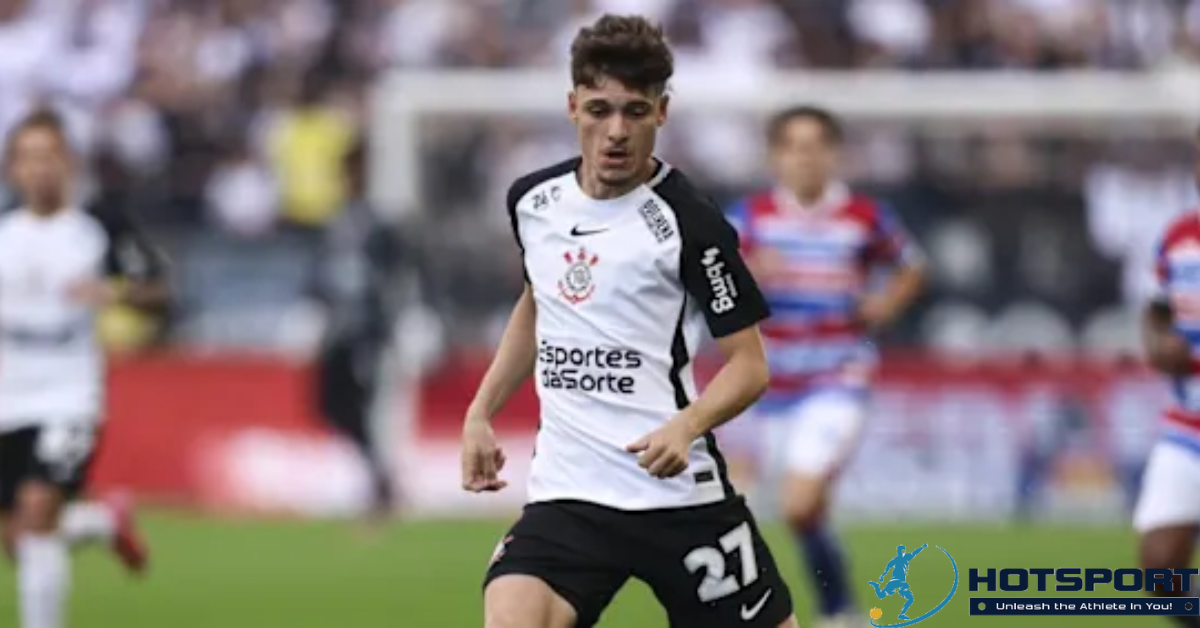
The 2024 Copa Libertadores tested him further. In the qualifying rounds, he scored his first international goal against Uruguay’s Nacional, securing progression. Those experiences forged his character, teaching him to handle long trips and sky-high expectations. By year-end, with his contract extended to 2029, Bidon had become an idol of the Fiel, with number 27 shirts flying off the shelves at Parque São Jorge.
2025: The Year of Consolidation – Stats and Highlights
2025 has been the year Breno Bidon truly arrived. Starting the season at 19 (turning 20 in February), he claimed an undisputed starting spot in Corinthians’ midfield under Argentine coach Ramón Díaz. In Série A up to December, he has played 33 matches (31 starts) and accumulated 2,522 minutes. His numbers are impressive: one goal (a beauty against Flamengo in a thrilling draw), one assist, 0.9 tackles per game on average, and 71% accuracy on long passes.
The Timão, currently fighting for a top-half finish (13th but with games in hand), owes much to him. In an August derby against Palmeiras, Bidon orchestrated a comeback with three key passes, including the one that led to the winning goal. In the Copa do Brasil round of 16, he was pivotal in neutralizing Bahia’s midfield with tight marking.
Minor injuries, such as an ankle sprain in June that sidelined him for two weeks, only made him come back stronger, working with renowned personal trainers. His market value has soared to €12 million according to Transfermarkt, reflecting his immediate impact. In interviews with ESPN Brasil, Bidon remains humble: “I’ve been playing for Corinthians since I was a kid. Every match is a chance to give back what the club has given me.”
Brazil Under-20 Call-Ups: Answering the Green-and-Yellow Call
Bidon’s talent extends beyond the club. In 2025, he was called up to the Brazil under-20 team for the South American Championship held in Argentina. Playing all nine matches and scoring once—a fine header against Colombia in the quarter-finals—Brazil lifted the trophy, with Bidon serving as stand-in captain. “He’s the brain of the team. He organizes everything calmly, even under pressure,” praised head coach Ramon Menezes.
Those performances earned praise from senior national team boss Dorival Júnior, who is closely monitoring him for future call-ups. Bidon dreams of the 2026 World Cup, and the under-20 stage is the perfect springboard. In friendlies against European sides like Spain U-21, he showed maturity with 90% pass accuracy and a brilliant assist.
European Interest: On the International Radar
It’s no secret that foreign eyes are fixed on São Paulo. In February 2025, rumors linked Bidon to Arsenal and Tottenham, with reported offers around €15 million. By June, Wolves and Fulham made inquiries, while giants Real Madrid and Barcelona added him to their prospect lists.
The buzz grew in November when Atlético Madrid, under Diego Simeone, showed concrete interest at €18 million. “Breno fits the profile Simeone loves: combative, intelligent, and with a sharp left foot,” an agent told Gazzetta dello Sport. Corinthians’ board is holding firm, prioritizing the player’s development, but an irresistible offer could change everything in 2026.
Bidon himself stays grounded: “My dream is to play in Europe, but I’ll only leave the Timão if it’s best for everyone.” His mature stance only adds to the hype.
Playing Style and Qualities: Why Bidon Captivates
What makes Breno Bidon special? His style is a rare blend: the peripheral vision of a playmaker, the grit of a defensive midfielder, and the finishing touch of an attacking midfielder. A natural left-footer, he loves mid-range shots and surprise runs into the box. Defensively, he covers space well, averaging 2.1 interceptions per game in 2025.
Often compared to Wolverhampton’s João Gomes, Bidon stands out for his elegance. He may not be the fastest, but he compensates with positional intelligence. Coaches describe him as a “silent conductor” who lifts his teammates without fanfare.
A Bright Future: Challenges and Expectations
As he approaches his 21st birthday, Bidon faces his biggest test yet: maintaining consistency at a Corinthians that swings between glory and struggle. With the 2025 Brasileirão nearing its end in December—and a recent 2-1 defeat to Fortaleza in which he played 66 minutes—he knows 2026 will be decisive. Goals? A Série A title, a Libertadores spot, and perhaps a senior national team call-up.
Off the pitch, Bidon is committed: he supports social projects in Osasco, visits youth football schools, and uses his social media to promote inclusion in sport. Still deeply tied to his roots, he balances family and career with admirable poise.
Conclusion: A Name to Remember
Breno Bidon is not just a player; he is the symbol of a Brazilian generation that is once again turning youth academies into cradles of idols. From childhood dreams to the lights of the Arena Corinthians, his journey inspires thousands. While the football world debates his next move, one thing is certain: wherever he plays, Bidon will carry the Timão’s DNA and São Paulo grit. Brazilian midfield has gained a new chapter—and he is its protagonist.