Introduction – West Ham vs Liverpool
On Sunday, November 30, 2025, West Ham and Liverpool faced each other at the London Stadium in a Premier League 2025/26 match. The duel, surrounded by pressure on both sides, ended with a 2-0 victory for Liverpool. The match represented not only the search for three points, but also a chance for recovery for the Reds after a disastrous run of form, and for West Ham to move away from the relegation zone.
The clash between West Ham and Liverpool at the London Stadium carried a special weight. For Liverpool, it was a chance to breathe after weeks of chaos, criticism, and doubts about Arne Slot’s work. A club accustomed to competing for titles found itself immersed in its worst phase in seven decades. The consecutive defeats were not just numbers, but symptoms of a team that was emotionally fragile, unable to transform dominance into results.
On the other side, West Ham treated the match as an opportunity to reconnect the team and the fans amidst the fight against relegation. The tribute to Billy Bonds created an emotional atmosphere, but also added expectation: the team needed to respond on the field. They lacked consistency, composure, and a collective performance that represented the club’s competitive spirit.
The atmosphere before kickoff made it clear: this wasn’t just another Premier League game. It was a test of emotional, technical, and tactical survival for two clubs seeking completely different paths in the season. The way Liverpool reacted and how West Ham became disorganized throughout the match tells a much bigger story than the simple 2-0 scoreline.
Pre-game – Atmosphere, context and what was at stake
Pressure on Liverpool
Liverpool came into the match under pressure. The team was coming off an alarming run of poor results — nine defeats in their last twelve games across all competitions, their worst run in 70 years.
Furthermore, there was anticipation surrounding manager Arne Slot, who opted to leave star player Mohamed Salah out of the starting lineup for the first time in the Premier League since April 2024.
The pressure was immense: he needed a result that would represent a genuine return of confidence and competitiveness.
West Ham: a chance to breathe
For West Ham, the game represented an opportunity to escape the relegation zone. The team, vulnerable defensively, was seeking stability under the recently hired manager Nuno Espírito Santo — and needed to take advantage of playing at home.
Furthermore, the match carried an emotional weight: the club paid tribute to its legend Billy Bonds, who had recently passed away. The fans were seeking extra encouragement and motivation.
For both sides, it was more than just three points: it was a watershed moment.
Formation, strategy and start of the match
Liverpool started with a 4-2-3-1 formation, making changes in an attempt to break their goal drought. Salah’s absence was compensated for by the inclusion of Alexander Isak in the starting lineup – an expensive signing who had previously failed to score in the Premier League for the Reds.
West Ham lined up in their traditional 4-2-3-1 formation, attempting to utilize quick transitions and crosses, while also aiming to mobilize the crowd as an extra factor at the London Stadium.
During the first half, Liverpool maintained reasonable control of the ball, alternating between patience in build-up play and speed in transitions. But the chances created were neutralized by West Ham goalkeeper Alphonse Areola, who made some good saves.
West Ham, in turn, sought to press on counter-attacks and balls created down the wings, but lacked precision in their finishing.
Second Half – Turnaround, goals, and the drama of the sending-off.
The final stage brought a decisive change of pace. In the 60th minute, Alexander Isak finally broke his Premier League goal drought: he received a pass from Cody Gakpo and struck with precision to open the scoring. It was the Swede’s first league goal in a Liverpool shirt.
The goal changed the dynamics of the game. Liverpool gained confidence, and West Ham felt the impact. The pressure increased, and the atmosphere at the London Stadium changed.
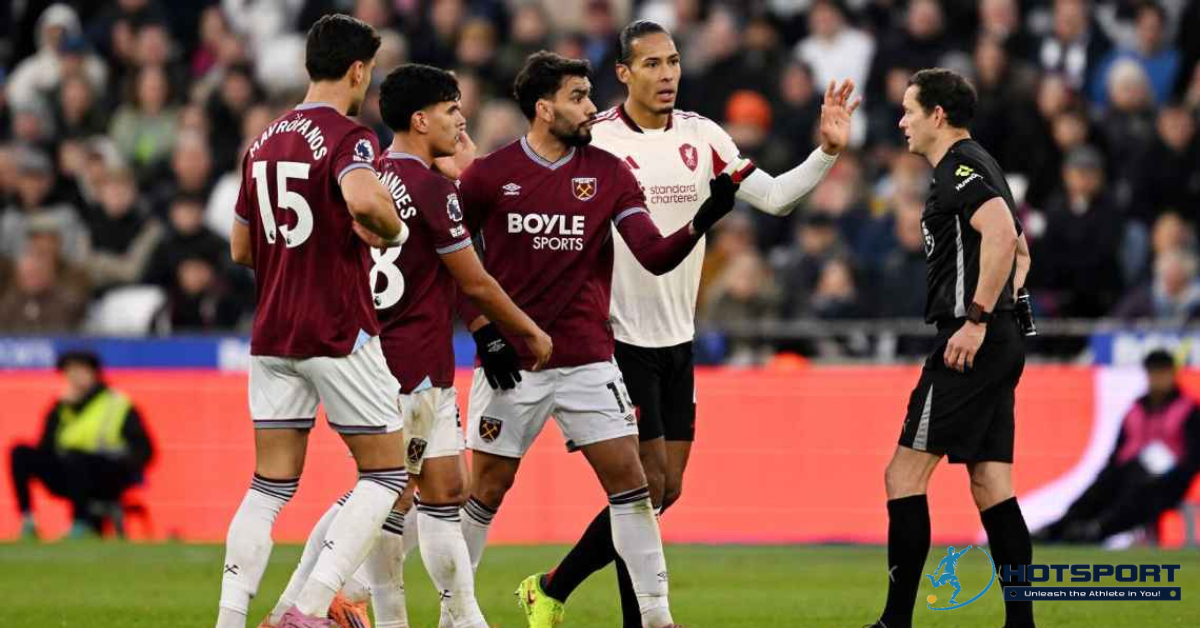
To make matters worse for the Hammers, in the 84th minute, midfielder Lucas Paquetá was sent off for excessive arguing with the referee after receiving two consecutive yellow cards. His departure made the situation even more difficult for the home team.
With a numerical and moral advantage, Liverpool held control until the end and, in stoppage time — at 90+2 minutes — Gakpo sealed the victory with a comfortable goal, making the final score 2-0.
Statistics and overview of the match – West Ham vs Liverpool
| Statistic | West Ham | Liverpool |
|---|---|---|
| Goals | 0 | 2 |
| Total shots | 7 | 14 |
| Shots on target | 0 | 5 |
| Clear chances | 0 | 3 |
| Expected Goals (xG) | 0.28 | 1.87 |
| Ball possession | 43.8% | 56.2% |
| Accurate passes | 356 | 482 |
| Passing accuracy | 81% | 87% |
| Disarms | 12 | 15 |
| Absences | 11 | 9 |
| Yellow cards | 3 | 1 |
| Red cards | 1 (Paquetá) | 0 |
| Corner kicks | 7 | 2 |
These numbers paint a clear picture: Liverpool were superior, more precise, and more emotionally stable when they needed to control the game.
Impact of the victory – Consequences for West Ham vs Liverpool
For Liverpool
- The victory breaks a terrible streak: the Reds had been on a run of defeats and poor results. This triumph represents a sigh of relief for the fans and coaching staff.
- Isak’s first Premier League goal for the club represents a significant turning point for the Swede, relieving pressure and boosting his confidence.
- The confidence gained from this game can fuel the pursuit of top positions and a climb up the table.
For West Ham
- Paquetá’s expulsion leaves a bitter taste: in addition to losing a player, the team compromised its offensive capabilities in the final moments.
- The home defeat complicates the situation at the bottom of the table and puts pressure on the team to react in the coming rounds.
- The situation demands defensive adjustments and greater tactical consistency — mainly to avoid individual errors that could cost games.
For the 2025/26 Premier League season
- The result reignites the rivalry between giants: Liverpool shows it remains competitive, increasing the uncertainty in the fight for the top spot.
- West Ham’s instability underscores the drama faced by teams struggling to stay out of the relegation zone—a classically unpredictable environment in the Premier League.
Individual analysis – Who stood out (and who disappointed)
- Alexander Isak : crucial. He broke the negative streak and gave Liverpool their first goal. His performance shows signs of recovery in fitness and confidence.
- Cody Gakpo : intelligent, involved, and accurate at the right moment, sealing the score and securing the three points.
- Florian Wirtz : He came on with the responsibility of supplying the attacking sector and helped maintain the creation of chances. His performance was praised for his daring attitude.
- Alphonse Areola : He was one of the few to stand out for West Ham. He made important saves in the first half, preventing the score from becoming even more unfavorable earlier.
- Lucas Paquetá : his expulsion changed the course of the match. His complaining attitude and lack of emotional control cost the team dearly.
The psychological impact of the first goal.
Isak’s goal in the 60th minute had an immediate effect on the behavior of both teams. Liverpool, previously tense and predictable, began to circulate the ball with confidence. Passes flowed more naturally, and the attack moved with more freedom. The team felt capable of controlling the game again.
For West Ham, the goal caused a disconnect. The defensive sector retreated too much, the midfield stopped compacting, and the transitions, previously quick, lost intensity. The team felt the emotional impact and couldn’t respond according to the game plan.
West Ham’s emotional collapse
Lucas Paquetá’s sending off didn’t come out of nowhere. The midfield was already showing signs of discomfort with Liverpool’s dominance, and the pressure from the fans demanding a reaction was weighing heavily. Paquetá, one of the team’s technical leaders, took responsibility but lost control.
A lack of emotional balance has become a symbol of West Ham’s current form. The team has talent, but fails to maintain composure in crucial moments, and this has cost them precious points.
Liverpool’s evolution without the ball.
Much has been said about Liverpool’s possession, but what really changed in this match was their behavior without the ball. The team pressed intelligently, closed passing lanes, and prevented West Ham from finding their playmakers between the lines.
Liverpool, who had been struggling with gaps left in defensive transitions, this time appeared compact and focused. Credit goes to Slot’s tactical adjustments, who finally found a balance between aggression and security.
The rebirth of Isak and Gakpo as a duo
The partnership between Isak and Gakpo breathed life into Liverpool’s attack. It wasn’t just about scoring, but about how they complemented each other:
- Isak attacked open spaces and won physical duels.
- Gakpo dropped back, organized plays, and chose the right moments to accelerate.
This complementarity, absent in previous games, gave Liverpool a new offensive dimension and could be a turning point for the remainder of the season.
Conclusion – West Ham vs Liverpool: recovery, pressure, and a fresh start
The West Ham vs. Liverpool match ended 2-0, but its significance goes far beyond the score. It was a resurrection game for the Reds, who managed to stop their crisis, regain confidence, and prove they are still in the fight.
For Liverpool, this is a victory that could serve as a turning point. Isak’s goal, the well-constructed defensive setup, and the return to defensive consistency reveal that, when focused, they can once again be a force to be reckoned with at the top. The collective performance was mature: patience in build-up play, speed in transitions, and efficiency when opportunities arose.
For West Ham, the defeat exposes technical and emotional weaknesses. The team needs to find balance, avoid lapses in concentration, and improve its control of the tempo. Paquetá’s sending-off highlights that discipline and composure will be essential for staying in the league.
For the Premier League, we have yet another demonstration of why the championship is one of the most unpredictable in the world: yesterday it was a crisis; a few plays later, a turnaround can happen.
If you enjoy detailed analysis, statistics, and comprehensive coverage of the major games, keep following our content.
FAQs – Frequently Asked Questions about West Ham vs Liverpool 2025
1. What was the final score of West Ham vs Liverpool?
Liverpool won 2-0 .
2. Who scored the goals in the game?
Alexander Isak scored in the 60th minute and Cody Gakpo sealed the victory in the 90+2 minute.
3. Was there a sending-off in the game?
Yes. West Ham midfielder Lucas Paquetá received two yellow cards for dissent and was sent off in the 84th minute.
4. Why is a win so important for Liverpool?
Because it ends a bad run of nine defeats in 12 games, restores confidence, and gives the squad morale to seek recovery in the Premier League.
5. Did West Ham play badly?
Not necessarily badly the whole time — there were defensive plays and good saves by Areola. But the sending-off and the lack of offensive efficiency compromised their performance.
6. Does this result change anything in the Premier League standings?
Yes. It continues Liverpool’s rise, reigniting their fight for the top spots. For West Ham, it complicates their struggle to avoid relegation.
7. Is Isak now poised to establish himself as a starter?
The trend suggests so — the goal gives him confidence and could accelerate his adaptation to the club.
8. What does West Ham need to improve?
Discipline on the field, greater offensive efficiency, and more defensive proactivity to avoid setbacks in crucial matches.